In our previous two blogs, The Revenue Growth Plateau and 7 Critical Bottlenecks for Stalled Revenue Growth, we explored why profitable companies can struggle to sustain growth and identified seven internal bottlenecks that can constrain revenue performance.
Having identified these potential bottlenecks, the next logical step is to understand their underlying causes. How does an organisation determine what is actually preventing revenue growth? More importantly, how does management decide where corrective action is needed?
The usual response is to increase the sales force, launch new campaigns, raise sales targets or introduce more aggressive incentives. However, these measures may increase sales activity without addressing the underlying problem.
In our view, this is like putting the cart before the horse. Before prescribing solutions, management needs to understand the root causes. This is where a comprehensive Sales Audit becomes one of the most valuable tools for identifying the constraints that are stalling growth.
1. So, what is a sales audit?
A Sales Audit is a focussed exercise and a comprehensive assessment of an Organisation’s sales ecosystem. This includes assessing sales strategy, offerings, customer outreach and engagement, processes, people, technology to assess how effectively they contribute to the revenue growth.
A company might have a good client base, but effective account management and account farming might be missing. It may have a good healthy pipeline, but conversion rate might be very low. It might be staffed with capable salespeople, who have done wonders in their previous company but are failing to replicate that success in their current Organisation. Or the other way around, it has right strategy, offerings and positioning, but is not staffed with the right set of people to take these to its prospects or customers. Maybe the tools it is using like CRM, lead gen, social media engagement etc. are outdated or not being effectively leveraged. The reasons can be many, and each of these requires careful analysis and an individualised response.
The purpose of a Sales Audit is to identify these underlying constraints, assess their impact on revenue performance and help management prioritise corrective actions. It’s a deep dive that goes beyond reviewing sales figures, target achievement or individual salesperson performance. It examines the complete sales engine to understand what is working, what is not working, and why.
The objective is not simply to improve sales activity. It is to improve the organisation’s ability to convert its market potential into predictable revenue growth.
2. Why a Sales Audit is needed?
In a nutshell, Sales Audit is needed to recognise and distinguish between symptoms and root causes.
Sales team might be capable but offerings of a company are not in sync with the market needs or vice versa. Management vision or mission is not being correctly understood by the sales team or it is not clear and does not establish quantified goals that can be clearly understood by the sales team. There could be weak lead gen engine, churning out low quality, under qualified leads. Poor ICP, unclear prospect engagement strategy etc. Heavy dependency of a few anchor customers and with these too a weak account farming strategy.
All these symptoms need a careful deliberation. If we treat these as a simple sales execution problem, we might end up with misleading or erroneous decision making. Sales Audit helps Organisations to identify these symptoms and identify the root causes. Once root cause is identified corrective actions can be initiated.
3. Critical areas that Sales Audit needs to examine
Ideally, all important aspects of an organisation’s sales ecosystem its interconnectivity with various functions, talent and technology should be covered by the sale audit.
Some of the critical areas are highlighted below:
a. Strategy and positioning
 As they say it starts from top and then percolates down. So, the starting point is to establish that the Organisation has a clear sales strategy which is in sync with the market needs and customer requirements. Is the strategy easily understandable with clearly defined objectives, goals and targets or is it a generic, unclear strategy that is very nebulous?
A Sales Audit should examine:
-
- Sales / GTM strategy to determine if targets, objectives are clearly defined.
- Operational strategy in sync with sales / GTM strategy.
- Understanding and alignment of sales strategy with the sales team.
- Customer focus, effective mapping of anchor customers.
- Positioning and differentiation w.r.t. competition.
b. Value proposition and ICP
 Are you selling your product or a technology or are you helping solve customer’s pain point. If former is the case then your value proposition is not in sync with what customer needs. A technically superior product or service does not automatically translate into a compelling sales proposition.
If the sales conversation focuses primarily on product features, technical specifications or technology superiority without establishing the business impact, the customer may struggle to understand why the offering deserves priority.
Further, based on the organisation’s strengths, domain expertise and capabilities, has it identified the customer segments where it can create the greatest value? Is your value prop in line with your customer needs. If not, then you have not defined an effective ICP. And if ICP is not properly mapped it will directly impact your sales engine.
Customers buy solutions to business problems. They may be looking to reduce operating costs, improve productivity, mitigate risks, accelerate time to market or increase profitability.
A Sales Audit should examine:
-
- Existing customer base, ICP and prospect list
- Value proposition is in sync with customer needs and requirements.
- If the value proposition delivering quantifiable benefits and if its addressing customer pain points.
- Organisation’s differentiation vis-à-vis competition.
- Sales enablement tools like marketing collateral, presentations, demos, proposal etc. their effectiveness in delivering the right message.
c. Business Development: Lead generation and healthy pipeline
Why do Organisations struggle to create a healthy pipeline, when they have a viable value prop and identifiable and addressable market. One reason, amongst the many could be that based on the ICP, leads are not being properly qualified, target ICP is not properly researched, budgets ascertained etc. It could also be possible that the business development and lead generation engine is not clear about the organisations offerings, their relevance to the defined ICP or this engine is not properly staffed with right kind of talent and required skills.

A Sales Audit should examine:
-
- Target market, account mapping.
- Tools employed for lead-generation channels including social media and their effectiveness.
- Marketing collaterals, positioning and offering decks, flyers, brochures etc.
- Lead / opportunity qualification and pipeline coverage.
- Funnel quality and the costs associated with it.
- Conversion rates at each stage of the sales funnel.
- Alignment between various stakeholders forming sales and business development teams.
- Talent that is manning the business development and lead generation teams.
d. Sales process and conversion effectiveness
This step involves a deep dive into organisation’s overall sales process. It involves review of each step in a sales process and ascertain if it is in line with the overall sales strategy. This step also involves a critical assessment of the overall sales conversion effectiveness.

Key areas to assess include:
-
- Sales and business development processes.
- Sales forecasting basis and its accuracy.
- Lead gen to order book timelines and duration. Identify reasons for delays.
- Opportunity mapping, qualification and ownership.
- Quality of proposals, clarity and crispness of solutions presented, decision maker mapping, budget validation and overall deal-closure planning.
- Consistency of the sales process across the team.
e. Sales talent, its capabilities and productivity
All of the above points will not be effective, if the sales and business development teams are not staffed with right talent with the required qualifications and capabilities. Sales people should be well versed with the industry domain, technology and customer base that they will be selling to. An experienced sales leader can lead the sales team to work in an efficient and productive manner.

A Sales Audit should examine:
-
- Sales and business development org structure.
- Experience and skill set required, quality of the sales team.
- Roles and responsibilities mapping with the team skill set.
- Gaps in experience, competence and capabilities.
- Gaps and challenges faced in talent acquisition.
- Sales enablement through proper trainings and skill set buildup.
- Sales incentive plans.
- Performance measurement and accountability.
- Overall Alignment between sales roles and business requirements.
f. Account planning, hunting and farming
Every organisation needs to have a strategic blueprint, related to the accounts it is catering to. Account planning is a structured road map that enables the sales team to effectively manage an account. It acts as a baseline in growing existing business within an account and look at new avenues to acquire new business.
Acquiring new customers and adding new business is where hunting comes in. It involves proactive outbound prospecting, identifying new opportunities, engaging potential customers and converting them into business.

A Sales Audit should examine:
-
- Existing and new business revenue mix.
- Account plans for marquee client, hero accounts.
- Cross selling and upselling.
- Experience and skill set of hunting and farming team.
- Customer feedback and satisfaction process and its implementation.
g. Usage of technology and tools
Technology is increasingly gaining importance in overall sales process. Various CRM tools, lead gen engines, social media, online presence are being extensively used to generate leads, acquire business and grow revenue. However, merely having these tools and technology will not help if there is no underlying robust process that enables the usage of such tools. The integrity and accuracy of data entered into these tools are also critical.

A Sales Audit should examine:
-
- Processes underlying usage of tools and technology and alignment between the two.
- Quality and adequacy of CRM tools being used.
- Quality and accuracy of customer related data being fed to these tools.
- Tools, dashboards used for sales forecast and reporting.
- Online and social media outreach.
- Use of AI to enhance sales effectiveness and productivity.
- Gaps in integration of various functions between sales, marketing, business development etc.
- Any technology gaps that affect sales productivity.
h. After-Sales Delivery and Its Impact on Revenue Growth
After-sales delivery is one of the most overlooked areas that directly impacts revenue growth. Many Sales Audits fail to adequately examine this critical function and its influence on an organisation’s long-term growth. Acquiring a customer is only the beginning of a relationship. Managing, maintaining and growing that relationship through effective delivery and customer engagement is equally important, whether the organisation offers products or services.
A Sales Audit should examine:
-
- Handover from sales to delivery
- Delivery capability based on the deals closed.
- Adherence to the commitments made during deal closure.
- Revenue leakage due to delivery issues post deal closure.
- Impact of delivery on account farming and growth.
4. In conclusion
A Sales Audit is not merely an exercise to critically examine functioning of a sales team. It goes much beyond that wherein all functions within an organisation that has a bearing on the sales function are critically examined. Sales Audit also stresses on the fact that revenue growth is not a sales function only.
Revenue growth does not end when an order is booked. The organisation’s ability to deliver what it has promised, maintain customer satisfaction and continuously develop existing relationships has a direct bearing on repeat business, customer retention and long-term revenue growth. All departments within an organisation – delivery, quality, customer care, senior management focus, play an important part in revenue growth.
A Sales Audit is not an end in itself. It is the starting point for making better decisions about revenue growth. The findings may indicate a need to refine market positioning, redefine the ICP, improve lead qualification, strengthen sales capabilities, redesign processes, improve CRM discipline or develop a more systematic approach to existing customers.
A Sales Audit provides management with a structured way to examine the complete revenue-generation ecosystem, identify the root causes of underperformance and determine where corrective action can make the greatest difference.
Our Sales Audit and Revenue Growth Assessment is designed to help organisations examine these critical areas, identify opportunities for improvement and prioritise the actions needed to strengthen revenue performance.
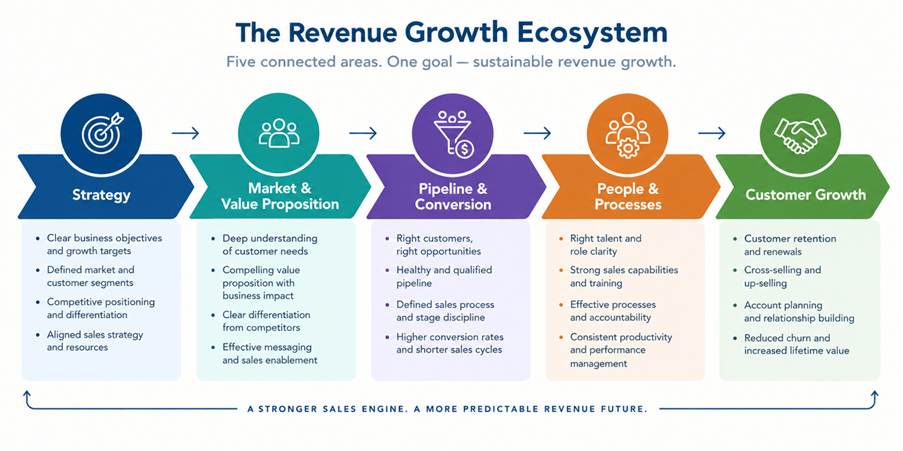
These areas are closely interconnected. A well-defined strategy needs the right positioning and value proposition. This needs to be supported by effective business development, a healthy pipeline, capable sales talent and disciplined processes. Equally important are the organisation’s ability to deliver on its commitments and continuously develop existing customer relationships. A weakness in any one of these areas can affect the overall revenue-generation capability of the organisation.
Before investing more in sales, make sure you understand what is holding it back.
To learn more about Plakxa’s Sales Audit and Revenue Growth Assessment, visit www.plakxa.com or call +91 96203 00550.